
To appear, IEEE Communications Magazine
Goal-Oriented Communications for Interplanetary and Non-Terrestrial Networks
A novel architectural perspective for the scale-up of Satellite and Space Connectivity.
GO SPACE concept and vision paper
A reference point for the GO SPACE research vision
The paper introduces the architectural perspective and core research pillars that connect goal-oriented sampling, access, computation, flow control, and routing across future SpaceNets.
You can find the concept and vision paper for GO SPACE here.
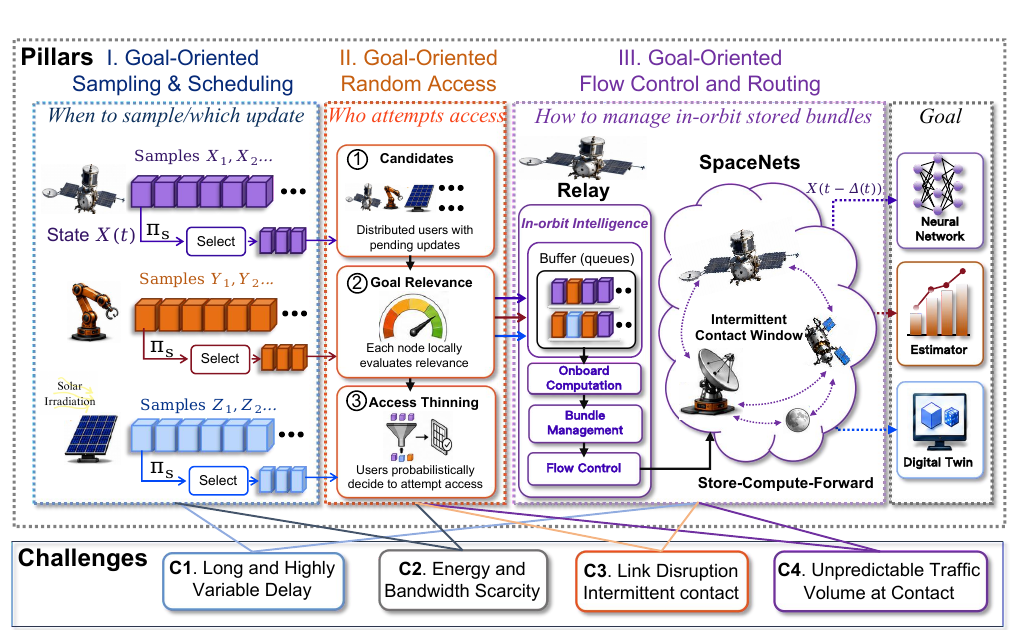
Research framework
Three connected pillars for mission-aware SpaceNets
The article connects source-side information generation, distributed channel access, and relay-side bundle management through a common notion of delivery-time value.
Goal-Oriented Sampling and Scheduling
Determines when information should be generated and which update should be served when communication opportunities, energy, and contact capacity are limited.
Goal-Oriented Random Access
Shapes offered traffic by allowing distributed sources to attempt access according to the expected task value of their information.
Goal-Oriented Flow Control and Routing
Enables relays to rank, reprocess, forward, retain, or discard bundles according to their remaining value and feasible delivery opportunities.
Store–Compute–Forward
Intermediate nodes do more than preserve queue order: they evaluate goal relevance under delay, storage, energy, and contact constraints, and spend scarce capacity on information expected to remain useful at delivery.
Why this publication matters
The article provides an overarching reference for the GO SPACE research direction and a protocol-level perspective for 6G non-terrestrial networks, satellite IoT, Delay/Disruption Tolerant Networking, and interplanetary communication. It links application goals to practical decisions across sampling, random access, onboard computation, bundle management, and routing.
Full paper
Read the complete publication
The PDF is embedded below for direct reading and remains available through the dedicated open-PDF link.
PDF viewer not displayed? Open or download the full paper here.